




Welcome to the Cairns Golf Club
Cairns Golf Club is a modern 18 Hole Championship Golf Course centrally located just minutes from the centre of Cairns in Far North Queensland, Australia. The Club has a fleet of 60 motorised carts is open for social play 7 days a week and has a full length floodlit driving range. We have a fully stocked Golf Shop with PGA Professionals on staff.
The modern air-conditioned clubhouse seats 120 people and is available for function hire.


Nominations for Office Bearers for 1960 were disappointing with five positions, including that of Captain, receiving no nominations. The Membership for 1959 was 336 of which 182 were Members and 126 Associates. The Financial Statement showed a profit of £63/10/11d. During 1959 the Cairns District experienced a long-wet season, which continued until the end of June, and this had an influence on the finances of the Club.
The dispute over the use of bar stools was again aired at meetings during 1960 but was again dismissed. The Financial Statement for 1960 showed that the Club had made a profit of £448/2/4d. The January Meeting confirmed the policy that ‘practice fees’ should be paid by Members practicing on the course, the only portion of the course not attracting the fees was the putting green. This rule would remain in force until it was rescinded some years later.
At the September Meeting, the President related discussions he had with the President of the Q.G.U, regarding an application for the staging of the Queensland Close Championships in Cairns in 1962. The club was advised the Event for the current year was decided, but it was possible to stage the Event in Cairns in 1963. Conditions applying included a Professional’s Purse of £250d, with leading players to be compensated for expenses outlaid by them.
A Motion at the November Meeting that “the sum of £1.200d be put aside for the installation of a Watering System, and that firm quotes be obtained, and considered, by a Special Committee consisting of the President, Secretary and Greens Committee” Motion was passed.
In 1962 The Membership stood at 404 which included 233 Members and 143 Associates. The Financial Statement showed a profit of £2,233/13/10d for 1961 as against £448/2/24d in 1960.In 1961 a debate arose regarding the wearing of ripple soled shoes, after receiving advice from Townsville, this type of shoe was banned from use on the Cairns course. A Notice of Motion was put forward rescinding the instruction, the subsequent March Meeting saw the instruction being withdrawn. The Queensland Close Championships in 1963 was discussed at the May Meeting. A dispute arose between the F. N. Q. G. A. and the Club, and staging of the event was deferred until after the August Meeting, a further application was made and accepted.
A complaint of Associates hitting up on Members during Saturday afternoon competitions was received at the May Meeting. The Meeting argued that while Members played in fours, Associates played in twos. The Associates were advised that in future, when a Members Fourball event was being played Associates must play the same event. Complaints were received of Members playing the course on Ladies Day, the Committee confirmed that Associates had exclusive rights to the course on this day.
The A.G.M. in 1963 showed a Membership of 355 including 212 Members and 120 Associates. The Financial Statement for 1962 showed a profit of £468/6/5d, a drop from 1961, reasons given were £1,291 outlaid on extensions to the Clubhouse and £1,567 for a new cold room. The Statement noted that wages jumped from £2,950 in 1959 to £4,350/0/0d in 1962.
The professional applied for permission to run the Saturday competitions, and for painting to have the Pro shop painted. Both requests were approved. Another request for permission to use space under the bar for buggy storage was refused, as it was allocated to the Steward as a parking area. He spent many hours before the Committee asking for more benefits or answering claims of misconduct. His major failing was his inability to attend to his duties as Professional. He was responsible for the introduction of the City of Cairns Golf Tournament.
The Queensland Close Championship was held in Cairns in June 1963, and was the 1st time an event of this importance was held on the Cairns course. The July Meeting received a report regarding the introduction of a Night Driving Range. The cost of installing the facility was £293 and was available from 7pm to 9.30pm on Tuesday and Thursday nights. In its first year of operation, it generated revenue of £260, but its popularity declined, and it closed after several years of operation.
A Real Estate Agent advised the Club in October 1963 that the property bordering its southern boundary, owned by Mrs. Alice Smith, was for sale. It was successfully moved, “that an offer to purchase the farm be made, subject to inspection. – an offer to be made after the inspection.” After inspection an offer of £2,750 was made. Several Meetings were called to discuss the purchase.
The first in December 1963 agreed to its purchase, but no steps were taken.
A second Special Meeting in January 1964 was told that Mrs. Smith had received a better offer than that of the Club. Mrs. Smith later claimed that the second offer was accepted as the Club made no payments, however, as the latest offer was not finalized, was the club still interested in the purchase of the land.
A third meeting called to discuss the latest offer and it was moved that Club advise it was not prepared to increase its offer of £2,750/0/d.” The motion was carried. In 1984 a private Land Valuer, valued the land in question at $250,000.00.
The December Meeting received a letter from the Qld. P.G.A. regarding the introduction of a
Queensland Circuit being introduced in 1964, inviting Cairns to be part of that circuit. It was moved, “that the Offer be accepted to include Cairns in the circuit, but that the actual amount of the purse be decided by next year’s Committee.” The motion was passed.
Membership for 1963 stood at 390, comprising 234 Members and 133 Associates, with a profit of £2,780/17/11d. Income for the year was £9,266/12/10d with Expenditure being £8,987/14/11d. The Annual Meeting agreed to increase the weekly rate paid to the Club's Secretaries of £10.
On advice from the F.N.Q.G.A. the Club agreed to a proposal that handicaps for Members and Associates used at Annuals be 24/18 and 30/23. That no green fees were to be charged for play on the practice fairway." The acceptance of this Motion would rescind a ruling that had been in existance for 42 years.
The Captain, at the April Meeting in 1964 advised that Saturday afternoon fields had increased with fields of 120 Members and 20 Associates playing. He recommended that starting times prior to 12.30 pm be used. He asked that Associates hit off after 1.30 pm.
An approach from the Queensland Branch of the P. G.A. necessitated the calling of a Special Committee Meeting in June 1964, to discuss arrangements regarding the tour by Queensland Golf Professionals, scheduled to play in Cairns on Wednesday 29th July. A purse of £200 was on offer and the Purse comprised the following—Donations £127, raffle £54, Calcutta £13 and entry fees £13. The Club was asked to consider the staging of a Professional / Amateur event in 1965 with a purse of £1,000/0/0d. Approval was granted but dates allocated were not those as requested by the Club and problems occurred, as the dates clashed with major events in Brisbane.
In January 1965 the Club reapplied for the event to be held on 1st August 1965,which was approved.
John Hadley was the driving force behind the "City of Cairns" Professional Tournament, which had its origins in 1965. The prospects of a Golf Tournament with a purse of a £1000 was, to most golf clubs outside the city area, a `pipe dream', and only a person with the drive of Hadley would be expected to attempt such an event. The dream would in fact become a reality. It would become the most successful event in Country Queensland.
Membership for 1964 was 417, made up of 242 Members and 139 Associates, the Club recorded a financial loss of £700. At the Meeting visitors green fees were set at 10/0d for Members and 7/6d for Associates. The Annual report noted that green staff employed by the Club numbered 2, with a third man being employed when necessary.
Members at the Annual Meeting resolved that Time Sheets be employed for Competitions in 50 percent of all events held. The Collection of green fees prior to 1965 were made by the Steward or Club Professional, a Special Meeting held in February 1965 resolved that Committeemen be rostered to collect fees on Competition days. The Roster was later abandoned when it was found impracticable, and the collection of fees were left in the hands of the President, Treasurer and Greens Committee. Up to the year 2000, competition fees are collected by the Match Committee, and would change after 2000 with fees collected by the Professional.
Reciprocal Rights were aired at Meetings during 1965 when the Captain advised that one visitor had been playing at the Club for the past four months using this concession. He advised that no limit had been imposed on his application. The Meeting resolved to review the whole issue, and the person concerned be interviewed to ascertain his intentions.
The first paid Secretary/Manager of the Club was appointed by the 1965 July Meeting, on a yearly salary of £1,500. The 1965 June Meeting dealt with replacement of a house for the Green keeper, which was in need of major repairs. A replacement house, located in Woodward Street, Edge Hill, was being rermoved for a Shell Service Station development, was bought for £600
The construction of a Piggery on the land owned by Mrs. Smith ( also known as Donaghy'paddock) was the centre of discussion at the October Meeting, with a petition being lodged with the Mulgrave Shire Council. The petition was to no avail, as the Council replied that prior approval had been sought and granted from the Council.

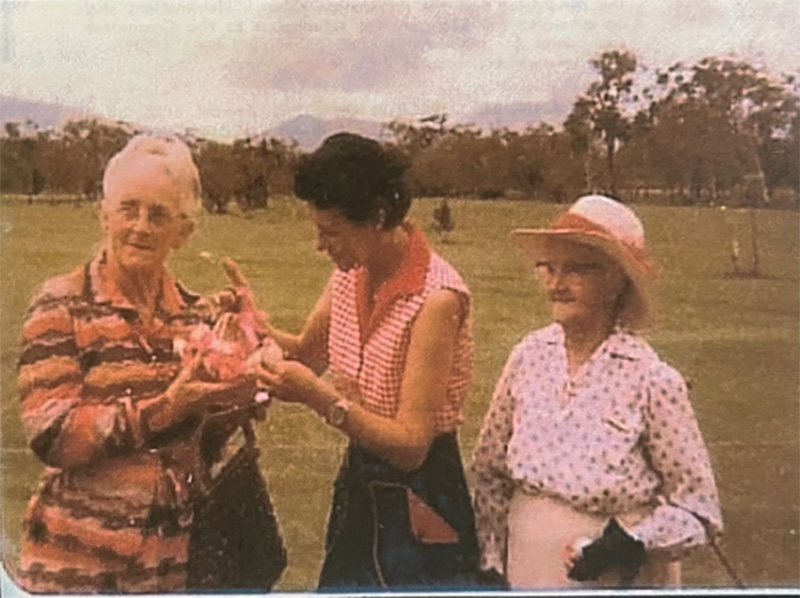
Muriel Pedersen, Mrs Barclay and Mrs H Hastie

Dot Berwick, Bet Shaw, Ethel Kerr, Marg Toovey, Bib Durant, Miss Jones, Thelma Upton
At the 1946 Annual Meeting Messrs. Langan and Griffiths were returned as President and Captain. The Membership in 1945 was 140. Dr Langan noted that this was the first peace time Meeting, and he expressed a desire that the Club continue along the lines for the forming of a proper Country Club. Mr. J. R. Warner retired as Treasurer after 17 years of service.
A Special Committee Meeting held in March 1946 decided that the Club should proceed with the reconstruction of the Course to 18 holes and to the gradual establishment of a “proper Country Club.” An amusing complaint was dealt with by the April Meeting, with reports on the behavior of the green keeper’s dog. The greenkeeper had trained his dog, an Alsatian, to find lost balls, which was of great benefit to players during the war years. However, complaints were now being received from players regarding the eagerness of the dog to “find” balls that had not strayed during rounds. The outcome was that the greenkeeper was told that the dog had to be kept off the Course during weekends.
Club Championships, in all grades, were reintroduced in 1946 and conducted in the following format - qualifying rounds were played over 18 holes, with the first eight in each grade qualifying. Quarter and semifinal rounds were also played over 18 holes with the final rounds played over 36 holes. It is not mentioned whether the finals were played in the match play format.
Nominations for Membership was discussed at the 1946 June Committee Meeting when Dr. Langan recommended that all nominations be dealt with at committee level. The Meeting resolved that all new members be elected by secret ballot, with one black ball in four, disqualifying a nomination. Criteria for Membership appears to have been high as the minutes record one application was rejected on several occasions. All applications for membership were to be left over for twelve months.
The A.G.M. in 1947 list the membership for 1946 at 169. In 1947 the Club still faced rationing, which included alcohol, some relief occurred when the Club was advised that quota had been raised to 54 gallons per month.
Areas of the course were still being cleared in preparation for the additional nine holes. A meeting held in February 1947 decided that at the completion of the work the contractors be retained, on an hourly rate, to finish off work that would otherwise have to be done by the Club’s staff. Since the outbreak of the war the Club did not employ the services of a Professional.
Reports to the 1947 October meeting advised that the work on the additional nine holes was progressing, with fairways ready for mowing by December 1947. Shortages of golf balls and beer were still a problem. The December meeting discussed ways of ensuring that enough beer was available for members to drink at the completion of their rounds. So that early finishers did not drink all the quota, tokens were issued on payment of Green Fees, and these were exchanged for drinks at the end of the round.
In 1947 an Industrial Award granted all workers a 40-hour working week. The law was enforced from 1st January 1948 and investigations were undertaken to see how it affected the golf club. The Steward and Green keeper were asked to work Saturday mornings for an extra 4-hour overtime, with other staff restricted to working the normal 40-hour week.
The last Committee Meeting held for 1947 was held in January 1948 and approval was given to the Associates to open their own bank account with the National Bank. The Treasurer also drew attention to the fact that the Club was overspending, and that due to the extra work being performed for the new course, the wages bill was more than the Club could afford. The 1947 meeting heard that the supply of golf balls had improved and that with this improvement outstanding trophies could now be paid out
The Membership for 1947 was shown as 233 comprising— Members 134, Associates 85, Country Members 5, Non-Playing Members 2, and Junior Members 2. Major expenses for 1947 were Construction of new 9 Holes and Extensions to watering scheme
The F.N.Q. Championships were held on the Cairns Course during 1947 and was won by Mr. J. R. Warner with Mr. G. H. Griffiths being runner up. An indication of handicap limits was revealed when Messrs. W. Woodward and H. Armstrong moved, “That visitors and new members be given a handicap limit of 25/18 until such time as they have produced three cards.” The Motion was lost.
The Annual Meeting attempted to elevate Mr. G. H. Griffiths to Life Membership, but on the advice of the President, was withdrawn. The President advised the Meeting, that the Constitution did not allow for a Life Membership to be given for services to the Club. Steps were put into place to amend the Constitution, and at the 1950 annual Meeting Mr. Griffiths received his Life Membership.
No records exist as to when the first 18 holes were played on the new course, but mention is made at the Annual Meeting in February 1948 that the first 18 holes would be played on the new course in April of that year. However, an official opening day set down for 1949 was postponed due to bad weather. The March Meeting in 1948 noted that with the opening of the new course, problems could be experienced with high tides and several springs would need draining. It can be reasonable to assume that the Course opened in either March or April 1948. The February Meeting approved the purchase of a tractor.
The existence of a C Grade is finally acknowledged at the May 1948 Meeting, when the handicap limits were set as follows – A Grade 12 and under, B 13 to 18 and C Grade 19 and over. The limits would stay until 1995 when they changed but would return to the above limits in 1998.
During 1948, several Cairns Members visited Townsville to compete in the Nth. Qld Championships, the major event was won by Cairns Member, Mr. R. Howarth. The teams event played in conjunction with the Championships was won by a Cairns side, being the first time that the Tyack Cup would be won by a visiting team.
The opening of the new Course was confirmed as 1948, when at its final Meeting in 1948 the Committee dealt with a complaint from Associates Members over the manner in which the change over to the new 18-hole course had been carried out. The Secretary was directed to write to the Associates apologizing for the oversight in the lack of notification. The Meeting invited Associates to play on the links during the off season on Saturdays, hitting off from the 10th Tee between 1 pm and 2 pm. The arrangements were for a trial period only.
The Membership for 1948 was 277, including 154 Members and 106 Associates. The President advised that the Q. G. U. had increased capitation. In the past this levy had been paid by the Club but in future it would be passed onto Members and included in their annual fees.
The February Meeting discussed the official opening of the new course. A Hole in One board was installed in August and the Committee agreed that any Member holing out would be presented with a bottle of scotch whisky.
The Committee was negotiating with Mrs. M. E. Golder on the sale of the land adjacent to the first fairway. On several occasions the minutes refer to the sale of this land and at least on one occasion a price was set, but each time the Committee of the day failed to proceed with the deal. A price believed to have been quoted was 1500 pounds or $3,000.00. The land was eventually sold to Mr. Donaghy, and the land would assume the title “Donaghy’s Paddock” in future chapters.
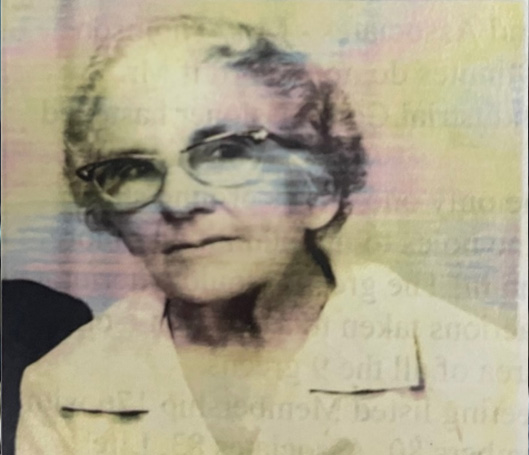 Mrs Annie Griffiths
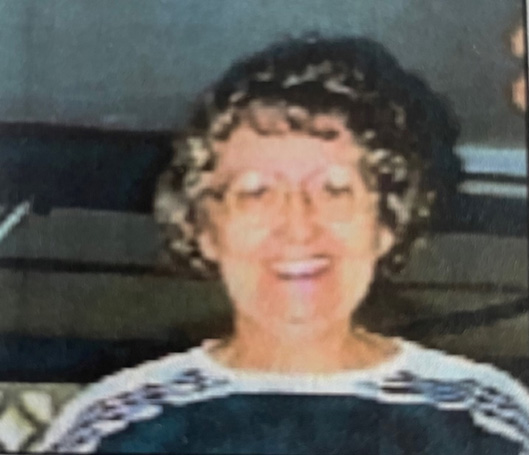 Miss Mary Kingsbury (top photo) joined the club in 1947 and would marry Charles Griffiths
 Mr H Hastie
The Annual General Meeting held at the Stand Hotel on 13th February 1940 was the first held during the War Years. The Annual Report showed Membership of the Club as 188, including - Members 90, Associates 82, Life Members 6, Country Members 4 and Non Playing Members 6. Included in the report was a statement showing that the whole of the Club's property had been converted to freehold, and that plans were in hand for the conversion of the course to 18 holes. The Club had made a profit of £204/0/4d in 1939 as against £109/8/7d in 1938.
The President, Dr. Langan, in his report blamed the reduction in the playing strength on
enlistments into the armed forces. Interestingly, the Annual Meeting dealt with several Motions in respect to enlistments, one being that Members enlisting in the services would be granted Life Membership of the Club. This offer was never taken up, Members later returning to play were never made Life Members. Resolutions passed at Meetings confirm handicap limits of 27 were applied. Tournaments were restricted to daily rounds of 27 holes. The 1940 December Meeting received a Motion from Mr. Griffiths, “that as the number of Members playing on Saturday afternoons has declined, it may be in the best interest of the Club if Associate Members were allowed to hold competitions on these afternoons.” Mr. Griffith’s Motion lapsed for the want of a seconder.
A Special Meeting in December 1940 discussed the appointment of a Greenkeeper and Mr. Bob Thomson was appointed. The appointment conflicted with the agreement previously in force with the Club’s Professional, Mr. Leo Corry, who did the work, and for which he was receiving additional wages. Corry objected strongly to the new appointment, and threatened, that if his additional revenue was denied, he would leave the Club. In the end Corry was offered 2-1/2 days’ work at award wages, which he accepted. His services were terminated during the war years, but he remained in the district and was reinstated as Professional at the end of hostilities.
The Annual Meeting held at the Strand Hotel in February 1941 saw the election of Mr. G. H. Griffiths as Captain, a position he held for 11 years, the continuity being broken only once in 1949. Other long serving Captains in the Club’ history would be K. A. G. Wilkinson 11 terms and G. D. Gummow 9 terms. The Annual report showed that the Club made a loss in 1940 of £193/5/3d. green fees were down by £92/0/0d and subscriptions by £69/0/0d.
During the early part of 1941 a request was received from the Associates Committee to change their golf day from Thursday to Tuesday afternoons. The request was granted, with the proviso, that the ground staff would not cut or prepare greens for Tuesday play. The playing day would remain in effect until after the end of the war. Reasons for the change was explained by Mrs. Pedersen "that Thursday afternoons during the war was "Red Cross Day" and many of the Associates were active in this organisation".
Although the interest of Committee Members was focused on the interests of the Club, in money matters, they were clearly orientated towards their own welfare, as is clearly pointed out in the Minutes shown for the February 1941 Meeting. At this meeting the Committee moved the following Motion, “That the Committee purchase a casket ticket at each monthly meeting, in the event of the ticket inning first prize, £2,000/0/0d was to be handed to the Club with the remaining £4,000/0/0d divided among Committee Members."
 G. H. Griffiths
A Truly remarkable man.George served the Club continuously for 41 years and 8 months as Committeeman, Vice Captain, Captain 11 Terms, President, 6 Terms, and Patron.
His wife, Annie, served on the Associates Committee for 23 years. With his brother Jack he guided the Club through the turbulent war years of 1939 to 1945.
George, the Principal of Advanx Motor Work, with sons Charles and Thomas were Club Champions. All three held the Club Championship on numerous occasions..
George, his wife Annie, brother Jack and his eldest son Charles were elevated to Life Members.
In 1998 the ashes of George and his wife were buried beside No. 8 Tee and a monument erected to honour their work. A photo of the memorial which stands at the front of Tee No.8 is shown below.
An interesting item to come from the Committee Meeting held in January 1942 was a Motion put by Messrs. Griffiths and Draper, "That the Club reimburse the Greenkeeper, Mr. R. Thomson, for two bicycle tyres and tubes that had been worn out by him in the services of the Club." The push bike was used to transport him, or his offsider, or perhaps both, to various parts of the course.
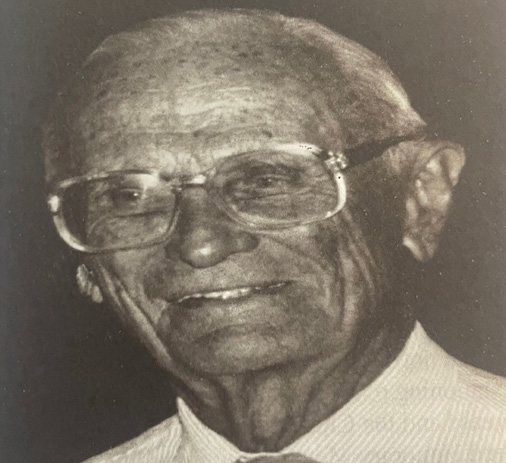 Mr. J.R. Warner
Son of Mr. S. H. Warner. Jack Reid Warner was Vice Captain of the Club in 1928, and Treasurer from 1929/45 inclusive. Vice President from 1946/1953 inclusive and Club Champion from 1927/1936 and again in 1938 and 1946, a total of 12 Titles
The Championships were not played from 1942.1945 due to the Second World War. Mr. Warner returned to the Club as Patron in 1973. At the start of World War Two Jack Warner was the Treasurer of the Golf Club, it was he who wrote the report that advised that Club that it was in danger of folding. He was elevated Life Member in 1975.
The Annual Meeting in 1942 was told that the Club had to prune its expenditure if it were to cope with prevailing conditions. Membership had declined due to resignations, brought on by
enlistments, plus a lack of petrol to transport players to the Club. The March Committee Meeting in 1942 again referred to the serious falling off in attendances, which it attributed to petrol restrictions and suggested that the Club may be forced to close its operations if the situation did not improve.
Shortages due to the war took its toll, with the supply of golf balls becoming a serious problem. Trophies were normally golf balls, but with the shortage of balls, the practice was discontinued and savings stamps were substituted. Complaints were received from Members, but fell on deaf ears. The May Committee passed a special Motion, granting military personnel special priveleges when on the course. They were treated as guests of the Club and not subject to green fees. As the Minutes will later show this privelege did not last long. In 1942 the stationing of Australian and U.S. servicemen in the Cairns area saw the numbers of servicemen greatly increase and the Club could not afford to miss out on additional revenue.
Australian troops occupied the empty Greenkeepers cottage with the Club being offered a rental of £10/0/0d per week. Since the inception of the Club, Meetings were held at the Strand Hotel on the Esplanade. when the U.S. Army commandeered the hotel for its exclusive use, Meetings were transferred to the offices of Mr. C. Woodward, the first Meeting being held there in August 1942. The U.S. Army had made approaches for the use of the golf club as an officers club but this was refused by the Committee.
The Years from 1939 to 1945 were by far the most interesting in the history of the Club. The economy of the country was in a sorry state this reflected in the finances of the Club which was on the verge of disbanding, but with the arrival of U.S. troops and the stationing of Australian personnel on the Course saw a change in this direction. Evening functions held by both U. S. and Australian forces were increasingly popular. Major Crowe of the 26th Australian Corps. A. C. S. applied to hold weekly dances, which were approved with a hiring fee of £6/0/0d per night, the same as for the Americans. Crowe queried the amount and the Committee agreed to lower the fee to £5/0/0d per night. However, the Americans were still charged at the higher rate. The reasons for the change is not recorded, but history will reveal that Australian personnel were paid a lot less than their American cousins and as the hall was being hired to fellow Australians it is reasonable to assume that this may have been the reason.
Beer supplies, or the lack of, and the presentation of war stamps in lieu of golf balls as trophies were among the main topics discussed at the January 1943 Meeting. Jack Griffiths, the House Chairman, told the Meeting the Club needed a further nine gallons of beer per week to meet the needs of drinkers visiting the Club. Brother George told the meeting, that Members complained about the presentation of war stamps in lieu of balls, but no action was taken on this matter and the Committee remained firm. Local liquor merchants were insisting, that spirits were hard to obtain, the Club must take half the whisky quota in Australian brands. The suggested choice was a well known Australian brand "Corio" and old timers would shudder at the thought of such a choice.
U. S. and Australian troops were holding weekly dances in the clubhouse and although
finances were improving the supply of beer and golf balls caused great concerns. Records show that George Griffiths always managed to keep Members supplied with golf balls. George introduced local rules to assist them. One such local rule was – “Members are allowed to change their golf balls once reaching the putting surface of greens.” Under this rule, Members hit off the tee and played fairway shots with badly marked balls, but on reaching the green the balls were replaced with one of better quality.
Mr. Jack Woodward, recalls that the Club always made special welcome to U. S. officers playing the course, mainly because they always had good supplies of balls, several of which usually finding their way into golf bags of Members. The influx of golfers playing on the course, the army personnel stationed in the area, created problems for the Committee. Three anti-aircraft guns were placed on the course, and at one Meeting, it was reported that troops on the course were incorrectly attired, playing the course with their shirts off. Army vehicles were using the Committee parking area and troops used the locker room for showering. Etc. The Meeting resolved that this must stop. Locks were placed on the entrances to all facilities and approaches made to the officer in charge of the troops requesting that they enforce the correct dress standards and prevent troops from using the Club’s facilities. War or no war, correct dress standards had to be observed.
Worse was to come, and when it was found that troops were drinking more than their share of the beer quota, the Committee got really upset. George Griffiths advised that with the increased use of the Course by servicemen, extra beer quotas were necessary. In one week, 72 servicemen used the Course - Prior to the arrival of the troops, a good week would see 25 players on the course. Increased quotas were applied for, but what really upset George was how the beer quota was being consumed.
At the October Meeting, George reported that golf playing servicemen played three holes and then retired to the bar for drinks, continued for a further three holes, repeating the procedure again and again until their round finished. In one Saturday afternoon, nine gallons of beer had been consumed. This procedure severely stretched the available beer quota and the drinking habits of these players depleted stocks, sometimes denying Club Members a drink on the completion of their rounds. The Committee moved swiftly passing a Motion, that the sale of beer would be restricted until the first gaggles in the competition completed their rounds.
Towards the end of 1943 troops were being moved out of Cairns and this was having an effect on bar profits. However, the Club received additional revenue by renting the spring, situated to the left side of the present 13th fairway to the Wrotham Park Grazing Co. for watering of their stock, and a fee of 1/0d was set.
Even though the war had turned in favor of the Allies, rationing of most commodities was still in force. Rationing not only effected the supply of beer and golf balls, but also linen. Jack Griffiths advised the Committee that the Club’s supply of tea towels and other towels should be replaced. during, and after the war, all linen, towels, and other materials could only be obtained by surrendering the necessary number of coupons. She stated that 56 coupons were allowed per person, per year, for the supply of clothes.
In 1944 American an Australian troops garrisoned in the far north were being withdrawn and sent to other areas. The Membership of the Club was listed as totaling 85, including 48 Members, 28 Associates, 6 Life Members, one Country Member, one Junior Member and one Non-Playing Member. The Club was subjected to severe shortages, as was the entire country, and difficulties were being experienced in obtaining a supply of golf balls and alcohol. The President, Dr. A. M. Langan advised the Annual Meeting that available golf balls would only be distributed to Members, and no balls were to be sold or given to visitors, nonmembers, or service personnel.
In 1944 the course consisted of 9 holes with a bogey, or par, of 36. Associates played a par of 37 with their 8th hole being a par 4. The par for each hole in order of play was - 4, 3, 5, 5, 3, 4, 5, 3, and 4. In 1944 Members and Associates played the same rating, except number eight. Approaches to the Sub Collector of Customs resulted in the Club receiving an increase in its wines and spirits quotas, bringing it to 10 gallons of spirits and 24 bottles of wine. Trophy winners in 1944 were presented with War Saving Bonds in lieu of golf balls. In the later part of 1944 the Club found itself with an overstock of Gin, and the Committee decided that until stocks returned to their normal levels, trophy winners would win bottles of Gin, in lieu of Bonds.
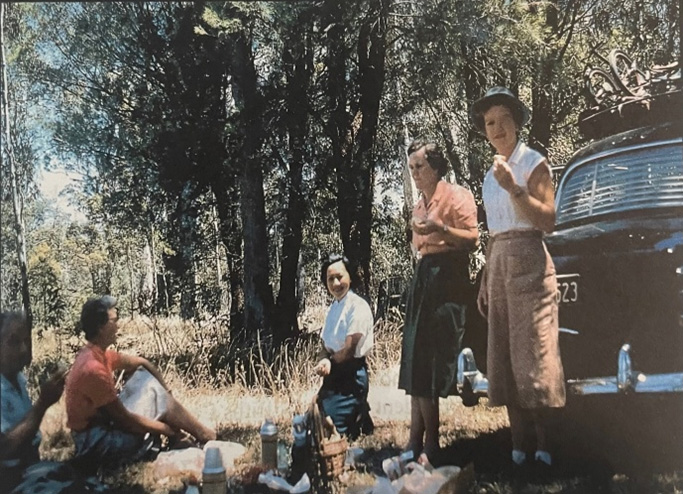
 cc
ccAt the Annual Meeting in 1945 Mr. N. P. Draper was elected as
Patron, Dr. A. M. Langan was returned as President and Mr. G. H. Griffiths as Captain. The Membership had increased from 85 to 117. Golf balls were still in short supply and the March Meeting received a circular from the Q. G. U. advising that if sufficient stocks of used balls were not returned to manufacturers for recovering, the game would suffer a serious decline due to the lack of balls. The non supply of golf balls was a very big problem, and in the years from 1944 to 1946 several local rules were introduced allowing Members to change their ball once on the green. Members carried a good ball for putting, using second class balls for other play.
Meals to Members would cost 2/6d with an additional 6d for sweets, with the price for afternoon teas being one shilling.
Dr. Langan was returned as President and Mr. G. H. Griffiths Captain for the 1950 golfing year. Membership in 1949 was 298 including 160 Members and 124 Associates. The President, Dr. Langan, passed away in June and Mr. G.D. Gummow was appointed as his replacement.
The Annual Report noted that £750 was spent on repairs to the clubhouse, as no contract had been entered into with the builder, and no permits obtained, serious problems occured with the Mulgrave Shire Council. Correspondence from the Bureau of Industry was received stating that as no permits had been obtained and legal action was being taken. Proceedings were instituted by the Mulgrave Shire and the Club taken to court, a plea of guilty was entered. The Club was fined £14/8/0d.
The first Business Girl's Carnival was played in 1951, becoming a popular event on the Members calendar for years to come— it was later discontinued. During the later half of 1951 visitors fees were raised to 5/0d for weekend play, and 4/0d at weekdays. Afternoon teas were raised to 1/3d. The Match Committee at the March Meeting, recommended that Club trophies £1/1/0d for first prize with two balls for second and third prizes.
Margot Allen, joined the Club in 1948, Ron Hastie, joined at the April 1951 Meeting. Club Professional, Leo Corry, resigned from the Club as from the 13th June 1951 and Denis Curby took up duty on 24th September 1951.
The Cairns Club initially provided members, at a fee, with garages, which not only garaged vehicles, but also to store personal equipment. The August Meeting noted that a total of 16 garages were provided. The Membership at the February A.G.M.was 392, including 191 Members and 168 Associates.
The printing of the 1952 Fixture book for the first time included the names of all Office Bearers. The Match Committee advised fields for May comprised – 66 players for the 3rd, 79 for the 10th, 66 for the 17th and 73 for the 24th. These were considered excellent fields. In June 1951 beer rose to 9d for an 8 oz glass and 7d for a 5 oz glass. The August and September Meetings 1952 debated ‘Holes in one,’ — “If a Member, Associate, Country Member or Junior Member of a recognized golf club, accompanied by a marker holed out in one, such person be presented with a bottle of whisky. Club Members will be presented at the Annual Presentations. In other cases, presentation be made on the day of the event, recognition on the Club’s Honor Board is confined to Members and Associates of the club.”
Mr Allen Smith was admitted to the Club in 1952 later resigned and rejoined in 1961. A photograph of the then Clubhouse was presented to the Club by Messrs. H. and N. Harris of Harris Bros. In June 1953, Ian Harris, son of Mr. N. Harris joined the Club. The Photograph was destroyed in the Clubhouse fire in 1973 and in 1998 Ian donated a copy of the photograph suitably framed to the Club where it now hangs in the Clubhouse.
Correspondence from the Associates Committee in the latter half of 1952 asked they be allowed to have their own President. The existing Associates Committee was comprised of a Captain, Secretary and General Committee of five. The Annual General Meeting in 1953 agreed to the request and the Associates Committee would now comprise of 9, including a President, Captain, Secretary and Committee of 6, this existed until 2000 when the position of President and the Committee structure would be changed.
The 1953 Annual Meeting saw Membership totaled 384 with 182 Members and 170 Associates. The February Meeting in 1953 dealt with correspondence from the Regional Electricity Board advising of their intention to construct power lines through the Course. A local rule passed at the Annual Meeting in 1956 gave players relief from overhead lines. The rule would remain in force until the lines were removed in 1998.
A Special Meeting in March 1953 recommended that Club Championships be played in three grades over 54 holes, - 18 holes being played on Saturday 4th July, and the final 36 holes on the following day. The formation of a competition to play Inter Club Pennants was addressed at a Meeting of Clubs in the Far North held in Atherton in March 1953.
The June Committee Meeting decided that garages had outlived their usefulness and should be demolished. The owners, except for one, agreed to the move. Mr. Warner at the 1954
January Meeting advised that the workload of the Secretary / Treasurer had grown, and it was time to employ a paid Secretary.
The Membership for 1953 stood at 424, 206 Members and 188 Associates. During 1954 several motions were put up and lost regarding dress standards on the Course, and in the Clubhouse, with the Committee finally ruling that irrespective of the weather, the correct dress must always be worn. A mini revolt ensured, and at the February Meeting “That in the event of correct dress not being complied with by 20th March, Members who defied the dress regulations would be banned from the course.” A further petition asking that the dress rules be relaxed, allowing for the optional use of long or short socks, to be worn with short trousers outside the Clubhouse, was put to a Special Meeting April 1954 where it was lost on a vote of 38 to 31.
Well known Australian Professional Golfer, Norman Von Nida held an exhibition and clinic on the Cairns course during May 1953. An attendee at the Clinic commented, although not complimentary, are none the less interesting – “I was present at the exhibition, and later when Mr. Von Nida attempted to conduct his clinic, two thirds of the gallery raced upstairs to the bar to get drinks after the conclusion of the exhibition match. Many of these leaned out of the open windows of the clubhouse drinking and watching as Mr. Von Nida commenced his clinic. The volume of noise coming from the bar and lounge through the open windows made it almost impossible to hear Mr. Von Nida. No move was made to stop the noise or close the windows, so Mr. Von Nida refused to continue with the clinic and retired.”
Mr. G. H. Griffiths asked at the June Meeting for permission to erect distance markers but was declined after receiving advice from the Q.G.U. that distance markers were unfair and not acceptable.
Other matters of interest occurring during 1954 were -
- – The Match Committee reported that Saturday fields averaged between 66 and 80 players.
- – A secondhand bicycle was procured for the green keeper for changing the water hoses.
- – To reduce “waste of time” a power point was to be installed near the Proshop for staff to ‘boil the billy.’ This was abandoned when it was discovered that the cost would amount to £40.
The Membership for 1954 was shown at 419, 206 Members and 184 Associates. Green and subscription fees for 1955 were to remain the same as 1954, but visitors’ fees were increased to 3/6d for affiliated clubs and 5/0d if not.
The Meeting also received a quote of £156 for the construction of a buggy room adjoining the Professional’s shop. The room was completed by July and Members were advised that all buggies stored in the locker rooms, and not in lockers, had to be removed. Storage could be obtained from the Professional at a fee of 5/0d per month. Catering had a very black chapter in the Club’s long history of difficulties connected with Stewards and Caterers, which history has been highlighted by only a few high spots. The number of satisfactory Steward/Caterers employed over these early years could be counted on the fingers of one hand. Curries and rice defy description – the Associates purchased the meat to make curry for one special occasion, and personally supervised the cooking of same, feeling that it was impossible for anything to go wrong; however, when the curry and rice was served it was as disastrous as usual; sponge cakes were at their best 1 inch thick; mixing icing sugar and water together and then poured over cakes; where it promptly ran off the top and down the sides.
Mr. McDonagh was appointed Greenkeeper in July 1955 with benefits being free rent and
lighting, plus a weekly wage of £13. The August Meeting also resolved that all players using the new practice fairway must pay green fees.
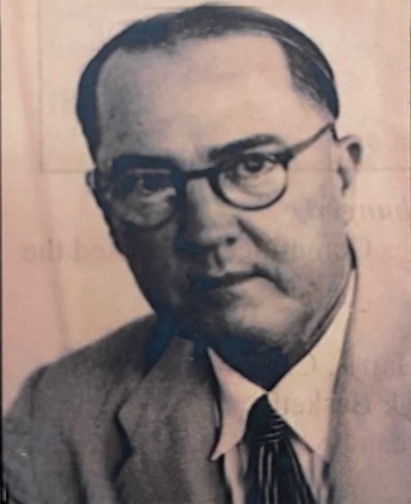
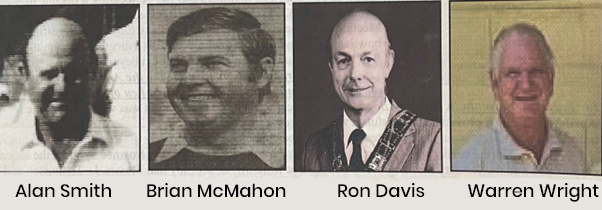
George Gummow

Ron Hastie

Margot Allen

Ian Harris
Allen Smith

Maud Way Nee Tung Yep
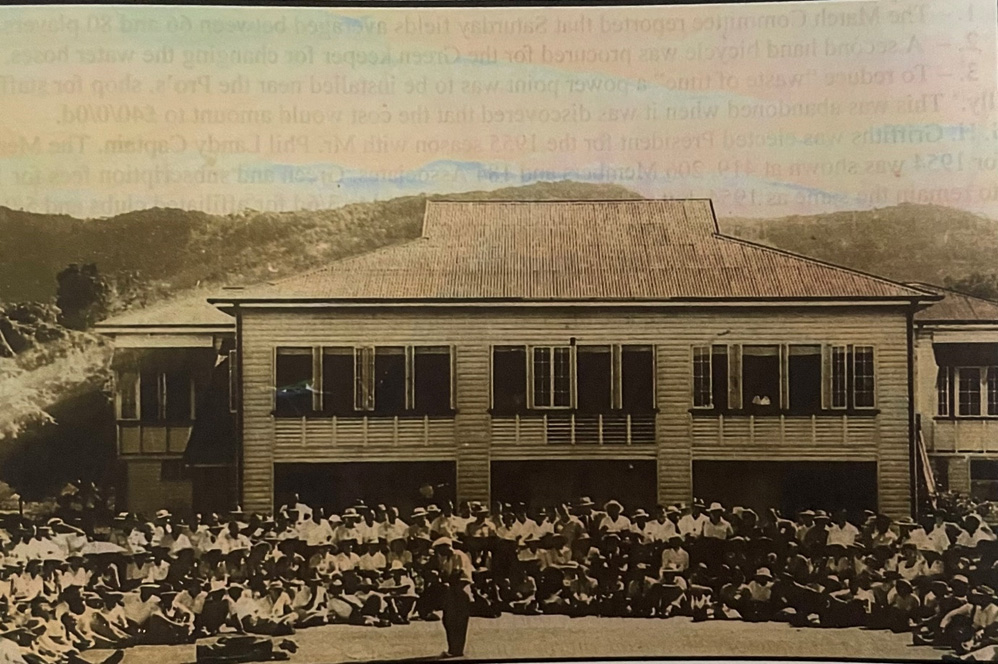
The Cairns Golf Club with Norman Von Nida in the middle of his Clinic
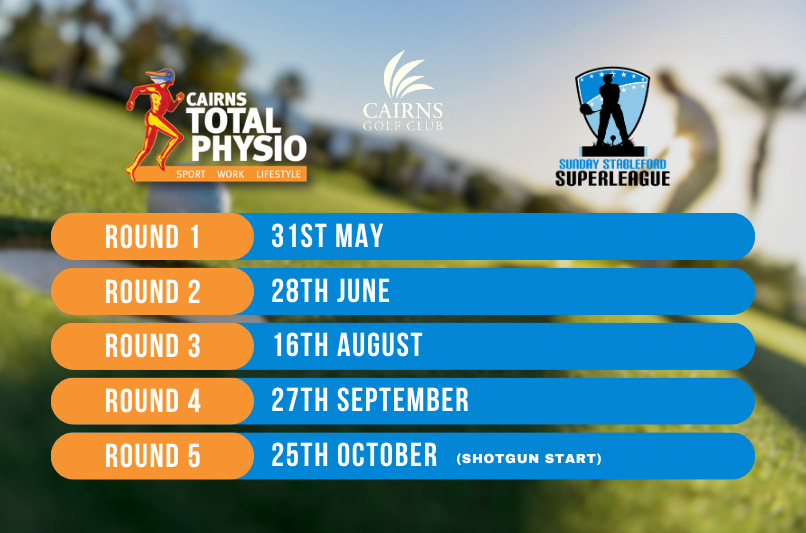
2026 Sunday Superleague


Get Into Golf Women’s Sessions


2026 Juniors Classes


School Holiday Junior Clinics


Every Girl Can


Every Girl Can


MyGolf Cairns Clinics

Annual General Meeting
 Notice of Annual General Meeting 2024
Links Drive, Woree,Queensland
Phone: (07) 4037 6700
Email: info@cairnsgolfclub.com.au
Click to view our Terms & Condition - Click to view our Privacy Policy
